> For the complete documentation index, see [llms.txt](https://docs.bimcat.org/llms.txt). Markdown versions of documentation pages are available by appending `.md` to page URLs; this page is available as [Markdown](https://docs.bimcat.org/user-manual/usage/tallycat-beta/sign-in.md).
# Sign In
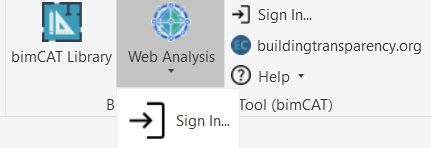
First, you’ll need to log in to your web account. Either click the **Sign in…** button in the BIM Climate Action Tool (bimCAT) ribbon, or go to **Web Analysis > Sign in…**
Please note that the plugin requires [WebView 2 from Microsoft installed](https://go.microsoft.com/fwlink/p/?LinkId=2124703). If it’s not present on your PC, the following dialog will pop up.
Click Download & Install to automatically install missing components to your system. After the installation finishes, restart Revit.
If you already have WebView 2, the plugin will start the login process.
Starting from the BIM Climate Action Tool (bimCAT) v0.10, the plugin uses the **OAuth2 authentication**. This means that the plugin will use your default system browser for performing the login and then store your login credentials between Revit sessions, so you’ll no longer need to sign in on every Revit start.
Upon clicking the **Sign in** button, the plugin will open your default system browser with the login form. Also, a progress dialog will be shown through the whole process of signing in, so you may cancel the login at any moment by either closing it or clicking the **Cancel** button.
You may either sign in by entering your login and password or use Google, Microsoft or LinkedIn login options.
After signing in through the form, you’ll need to give the BIM Climate Action Tool (bimCAT) the required permissions by clicking the **Allow** button.
If everything went fine, the browser will display the following page and the progress dialog will close automatically.
Now, you can close the page in the browser and switch back to the Revit window where the bimCAT ribbon should change.
* The ribbon **Sign in…** button changed its icon and now shows the user's login.\
If you click it, you will be signed out after a prompt.\
.png?alt=media)
* Under the **Web Analysis** drop-down menu, the **Sign in…** command became **Sign out** and also changed the icon. If you click it, you will be signed out after a prompt.
* If the current Revit project doesn’t have a 3D view called **bimCAT**, the drop-down menu will show a command that creates one. This view will be used later for all the operations performed by BIM Climate Action Tool (bimCAT).
* If the **bimCAT** view is already created, the ribbon will show additional commands: **Export to Web App**, **Open in Web App**, **Manage Scope**, **Detach from Web App**, **Properties & charts** and **Export to JSON**.

Depending on whether the project was exported to Web App or not, certain options will be enabled or disabled.
* You could click **Export to Web App** to start the export process instantly with the default settings, or you could go to **Manage Scope** to configure what’s exported first.
* If you exit Revit and start it again, you’ll remain signed in.
.png?alt=media)


